
Rice production is a significant agricultural activity worldwide which provides food for human consumption and the generation of large amounts of raw rice husk (RRH) as a by-product in which the disposal has become a serious environmental concerns. The aim of this study is to prepare and characterize rice husk ash (RHA) and rice husk carbon (RHC) produced from raw rice husk (RRH). The RHA and RHC are prepared from of RRH by burning of RRH in a muffle furnace at varying temperature by combustion process. The RRH, RHA and RHC samples were characterized and quantified using analytical techniques such as X-ray Diffraction (XRD), X-ray Fluorescence (XRF), Scanning- Electron Microscope (SEM), Transmission electron microscopy (TEM), Thermo gravimetric analysis (TGA), Fourier Transform Infrared (FTIR) Spectroscopy and Brunauer-Emmett-Teller (BET). The TGA results revealed that RRH, RHC and RHA samples have thermal stability at temperature which range from 222.40-327.6°C. The X-ray Diffraction (XRD) results identified four mineral phases for the samples RRH, RHC and RHA. The SEM images of the RRH, RHC and RHA samples revealed the spherical irregular particle morphology with different particle sizes and some agglomeration. The TEM further revealed the morphology of RRH, RHC and RHA to be spherical shape with particle sizes of 17.2 nm, 9.96 nm and 5.33 nm respectively. The FTIR adsorption spectra shows the stretching adsorption bands of functional groups in RRH, RHC and RHA with stretching and bending peaks of the samples from one form to another. The XRF results revealed the elemental composition of the samples RRH, RHC, and RHA revealed the elemental composition of SiO2, Al2O3, CaO, MgO, and Fe2O3. In conclusion, the RRH, RHC and RHA samples shows that products of the burning process have a higher quality than the raw samples.
| Published in | International Journal of Materials Science and Applications (Volume 15, Issue 2) |
| DOI | 10.11648/j.ijmsa.20261502.11 |
| Page(s) | 41-51 |
| Creative Commons |
This is an Open Access article, distributed under the terms of the Creative Commons Attribution 4.0 International License (http://creativecommons.org/licenses/by/4.0/), which permits unrestricted use, distribution and reproduction in any medium or format, provided the original work is properly cited. |
| Copyright |
Copyright © The Author(s), 2026. Published by Science Publishing Group |
Raw Rice Husk, Disposal, Combustion, Rice Husk Carbon, Rice Husk Ash, Characterization
RRH | Raw Rice Husk |
RHC | Rice Husk Carbon |
RHA | Rice Husk Ash |
XRD | X-Ray Diffraction |
WRHA | White Rice Husk Ash |
BRHA | Black Rice Husk Ash |
XRF | X-Ray Florescence |
SEM | Scanning Electron Microscopy |
TEM | Transmission Electron Microscopy |
FTIR | Fourier Transform Infrared Spectroscopy |
TGA | Thermogravimetric Analysis |
BET | Brunauer Emmette Teller |
IC | Ion Chromatography |
ICP-OES | Inductively Coupled Plasma-Optical Emission Spectrometry |
| [1] | Nguyen, H., Jamali Moghadam, M., & Moayedi, H. (2019). Agricultural wastes preparation, management, and applications in civil engineering: a review. Journal of Material Cycles and Waste Management, 21(5), 1039-1051. |
| [2] | Vander Donckt, M., & Chan, P. (2019). The new FAO global database on agriculture investment and capital stock. Food and Agriculture Organization of the United Nations. |
| [3] | Korotkova, T. G., Ksandopulo, S. J., Donenko, A. P., Bushumov, S. A., & Danilchenko, A. S. (2016). Physical properties and chemical composition of the rice husk and dust. Orient. J. Chem, 32(6), 3213-3219. |
| [4] | Daffalla, S. B., Mukhtar, H., & Shaharun, M. S. (2020). Preparation and characterization of rice husk adsorbents for phenol removal from aqueous systems. PloS one, 15(12), e0243540. |
| [5] | Raheem, A. A., & Kareem, M. A. (2017). Chemical composition and physical characteristics of rice husk ash blended cement. International Journal of Engineering Research in Africa, 32, 25-35. |
| [6] | Amran, M., Fediuk, R., Murali, G., Vatin, N., Karelina, M., Ozbakkaloglu, T., &Mishra, J. (2021). Rice husk ash-based concrete composites: A critical review of their properties and applications. Crystals, 11(2), 168. |
| [7] | Demir, Z., & Gülser, C. (2015). Effects of rice husk compost application on soil quality parameters in greenhouse conditions. Eurasian Journal of Soil Science, 4(3), 185-190. |
| [8] | Satbaev, B., Yefremova, S., Zharmenov, A., Kablanbekov, A., Yermishin, S., Shalabaev, N., ... & Khen, V. (2021). Rice husk research: From environmental pollutant to a promising source of organo-mineral raw materials. Materials, 14(15), 4119. |
| [9] | Abbas, A., & Ansumali, S. (2010). Global potential of rice husk as a renewable feedstock for ethanol biofuel production. BioEnergy Research, 3(4), 328-334. |
| [10] | Nawaz, S., Jamil, F., Akhter, P., Hussain, M., Jang, H., & Park, Y. K. (2022). Valorization of lignocellulosic rice husk producing biosilica and biofuels—A review. Journal of Physics: Energy, 5(1), 012003. |
| [11] | Siddika, A., Al Mamun, M. A., Alyousef, R., & Mohammadhosseini, H. (2021). State-of-the-art-review on rice husk ash: A supplementary cementitious material in concrete. Journal of King Saud University-Engineering Sciences, 33(5), 294-307. |
| [12] | Bhupinder Singh (2018). Waste and supplementary cementitious materials in concrete, in Handbook of sustainable construction (pp. 417-460). Elsevier. |
| [13] | Bae, C. J., Hossain, S. S., & amp; Roy, P. K., (2021). Utilization of waste rice husk ash for sustainable geopolymer: A review. Construction and Building Materials, 310, 125218. 41. |
| [14] | Singh, M. P., & Gupta, A. (2004). Utilization of agricultural residues as soil amendments. Journal of Environmental Biology, 25(1), 1-12. |
| [15] | Singh, R., Yadav, D. B., Ravisankar, N., Yadav, A., & Singh, H. (2020). Crop residue management in rice–wheat cropping system for resource conservation and environmental protection in north-western India: R. Singh et al. Environment, Development and Sustainability, 22(5), 3871-3896. |
| [16] | Kumar, S., Sangwan, P., Dhankhar, R. M. V., & Bidra, S. (2013). Utilization of rice husk and their ash: A review. Res. J. Chem. Env. Sci, 1(5), 126-129. |
| [17] | Arfat, N., Ahmed, F. S., Uzma, S., Chaudhary, S., Noreen, M., Khan, M. A., & amp; Ijaz, M. (2016). Rice husk: A review on applications, processing and prospects. Journal of Cleaner Production, 120, 86-97. |
| [18] | Bosenbecker, M. W., Cholant, G. M., Silva, G. E. H. D., Paniz, O. G., Carreño, N. L. V., Marini, J., & Oliveira, A. D. D. (2019). Mechanical characterization of HDPE reinforced with cellulose from rice husk biomass. Polímeros, 29(4), e2019058. |
| [19] | Gupta, N. K., Prakash, P., Kalaichelvi, P., & Sheeba, K. N. (2016). The effect of temperature and hemicellulose-lignin, cellulose-lignin, and cellulose-hemicellulose on char yield from the slow pyrolysis of rice husk. Energy Sources, Part A: Recovery, Utilization, and Environmental Effects, 38(10), 1428-1434. |
| [20] | Wu, J., Elliston, A., Le Gall, G., Colquhoun, I. J., Collins, S. R., Wood, I. P., ... & Waldron, K. W. (2018). Optimising conditions for bioethanol production from rice husk and rice straw: effects of pre-treatment on liquor composition and fermentation inhibitors. Biotechnology for biofuels, 11(1), 62. |
| [21] | Nigam, P. S., & Singh, A. (2011). Production of liquid biofuels from renewable resources. Progress in energy and combustion science, 37(1), 52-68. |
| [22] | Kumar, A., Roy, A., Priyadarshinee, R., Sengupta, B., Malaviya, A., Dasguptamandal, D., & Mandal, T. (2017). Economic and sustainable management of wastes from rice industry: combating the potential threats. Environmental Science and Pollution Research, 24(34), 26279-26296. |
| [23] | Bergmann, C. P., Gonzalves, & amp; M. R. F. (2007). Thermal insulators made with rice husk ashes: Production and correlation between properties and microstructure. Construction and Building Materials, 21(12), 2059-2065. |
| [24] | Girmay, M. (2019). Optimization and Characterization of Silica Synthesized from Rice husk (Doctoral dissertation, institute of Technology, Addis Ababa University). |
| [25] | Gautam, R. K., Sharma, S. K., Mahiya, S., & Chattopad hyaya, M. C. (2014). Contamination of heavy metals in aquatic media: transport, toxicity and technologies for remediation. Journal of Hydrology, 509, 582-597. |
| [26] | Vijaya, Idrishi, R., Singh, S., & Islam, M. (2025). Processing of Rice Husk and Its Applications. In Rice Husk Biomass: Processing, Properties and Applications (pp. 1-26). Singapore: Springer Nature Singapore. |
| [27] | Alam, M. M., Hossain, M. A., Hossain, M. D., Johir, M. A. H., Hossen, J., Rahman, M. S., ... & Ahmed, M. B. (2020). The potentiality of rice husk-derived activated carbon: From synthesis to application. Processes, 8(2), 203. |
| [28] | Moraes, C. A., Fernandes, I. J., Calheiro, D., Kieling, A. G., Brehm, F. A., Rigon, M. R., ... & Osorio, E. (2014). Review of the rice production cycle: by-products and the main applications focusing on rice husk combustion and ash recycling. Waste Management & Research, 32(11), 1034-1048. |
| [29] | Shan, D., Deng, S., Zhao, T., Wang, B., Wang, Y., Huang, J., ... & Wiesner, M. R. (2016). Preparation of ultrafine magnetic biochar and activated carbon for pharmaceutical adsorption and subsequent degradation by ball milling. Journal of Hazardous Materials, 305, 156-163. |
| [30] | Chaturvedi, K., Singhwane, A., Dhangar, M., Mili, M., Gorhae, N., Naik, A., ... & Verma, S. (2024). Bamboo for producing charcoal and biochar for versatile applications. Biomass Conversion and Biorefinery, 14(14), 15159-15185. |
| [31] | Telgote, A. R., & Patil, S. S. (2024). Study and application of various activated carbons and ash used in water purification techniques: a review. Pomegranate, 16(4). |
| [32] | Zhang, G., Feng, S., Kong, D., Liu, H., Chen, J., Zhang, Q., & Cai, S. (2014). Effect of acid modification on the production of activated carbon from rice husk for adsorbing methylene blue. Journal of Industrial and Engineering Chemistry, 35, 847-853. |
| [33] | Zhu X, Liu Y, Qian F, Zhou C, Zhang S, & Chen J. (2014). Preparation of magnetic porous carbon from waste hydrochar by simultaneous activation and magnetization for tetracycline removal. Bioresource Technology.; 154: 209–214. |
| [34] | Zou, Y., & Yang, T. (2019). Rice husk, rice husk ash and their applications. In A. K. Bhattacharya & A. Kumar (Eds.), Rice bran and rice bran oil (pp. 207-246). |
| [35] | Ugheoke, B. I; & Mamat, O (2012a). A critical assessment and a new research directions of rice husk silica processing methods and properties. Maejo Int. J. sci. Technol. 6, 430-448. |
| [36] | Thuadaij, N., & Nuntiya, A. (2008). Preparation of nanosilica powder from rice husk ash by precipitation method. Chiang Mai Journal of Science, 35(1), 206-211. |
| [37] | Ginting, E. M., Wirjosentono, B., Bukit, N., & Agusnar, H. (2014). Preparation and characterization of rice husk ash as filler material in to nanoparticles on HDPE thermoplastic composites. Chem. Mater. Res, 6(7), 2225-956. |
| [38] | Malhotra, C., Patil, R., Kausley, S., & Ahmad, D. (2013, June). Novel uses of rice-husk-ash (a natural silica-carbon matrix) in low-cost water purification applications. In AIP Conference Proceedings (Vol. 1538, No. 1, pp. 113-119). American Institute of Physics. |
| [39] | Feng, Q., Lin, Q., Gong, F., Sugita, S., & Shoya, M. (2004). Adsorption of lead and mercury by rice husk ash. Journal of colloid and interface science, 278(1), 1-8. |
| [40] | Sharma, P., Kaur, R., Baskar, C., & Chung, W. J. (2010). Removal of methylene blue from aqueous waste using rice husk and rice husk ash. Desalination, 259(1-3), 249-257. |
| [41] | Adam, F., Appaturi, J. N., & Iqbal, A. (2012). The utilization of rice husk silica as a catalyst: Review and recent progress. Catalysis Today, 190(1), 2-14. |
| [42] | Bañuelos, J. L., Borguet, E., Brown Jr, G. E., Cygan, R. T., DeYoreo, J. J., Dove, P. M., & Zhang, H. (2023). Oxide–and silicate–water interfaces and their roles in technology and the environment. Chemical Reviews, 123(10), 6413-6544. |
| [43] | Avila, L. A., Marchezan, R., & Walter, M. (2008). Rice: Composition and nutritional characteristics. Ciência Rural, 38(4), 1184-1192. |
| [44] | Bansode, J., Hiraoka, Y., Tamura, S., & Li, Y. (2018). Elemental analysis of rice husk biochar derived at different temperatures. Fuel Processing Technology, 178, 651-656. |
| [45] | Liang, Y., Yang C. Dong H. Li W., Hu H., XiaoY., Xu Z., Wang C., & Liu, Y. (2017). Facile synthesis of highly porous carbon from rice husk. ACS Sustainable Chemistry & Engineering, 5(8), 7111-7117. |
| [46] | Hossain, S. S., Mathur, L., & Roy, P. K. (2018). Rice husk/rice husk ash as an alternative source of silica in ceramics: A review. Journal of Asian Ceramic Societies, 6(4), 299-313. |
| [47] | Kumar, M., Sachdeva, A., Garg, R. K., & Singh, S. (2020). Synthesis and characterization of graphene prepared from rice husk by a simple microwave process. Nano Hybrids and Composites, 29, 74-83. |
| [48] | Sreesvarna, B., Pugalendhi, S., Subramanian, P., & Gitanjali, J. (2019). Characterization of Rice Husk for Sustainable Applications. Madras Agricultural Journal, 106. |
| [49] | Hadipramana, J., Riza, F. V., Rahman, I. A., Loon, L. Y., Adnan, S. H., & Zaidi, A. M. A. (2016). Pozzolanic characterization of waste Rice husk ash (RHA) from Muar, Malaysia. In IOP Conference Series: Materials Science and Engineering (Vol. 160, No. 1, p. 012066). IOP Publishing. |
| [50] | Bhutta, M. A. R., Sumadi, S. R., & Hussin, M. W. (2013). Properties of multi-blended cement mortars using agro-industrial wastes. Malaysian Journal of Civil Engineering, 25(1). |
| [51] | Bie R-S, Song X-F, Liu Q-Q, Ji X-J. (2015), Chen P. Studies on effects of burning conditions and rice husk ash (RHA) blending amount on the mechanical behavior of cement. Cem Concr Compos 2015; 55: 162–8. |
| [52] | Irwansyah, F. S., Amal, A. I., Diyanthi, E. W., Hadisantoso, E. P., Noviyanti, A. R., Eddy, D. R., & Risdiana, R. (2024). How to read and determine the specific surface area of inorganic materials using the Brunauer-Emmett-Teller (BET) method. ASEAN Journal of Science and Engineering, 4(1), 61-70. |
APA Style
John, A. M., Adekemi, M. B., Aisha, O., Blessing, F. B., Ayodeji, A. O., et al. (2026). Preparation and Characterization of Rice Husk Ash and Carbon from Combustion of Raw Rice Husk. International Journal of Materials Science and Applications, 15(2), 41-51. https://doi.org/10.11648/j.ijmsa.20261502.11
ACS Style
John, A. M.; Adekemi, M. B.; Aisha, O.; Blessing, F. B.; Ayodeji, A. O., et al. Preparation and Characterization of Rice Husk Ash and Carbon from Combustion of Raw Rice Husk. Int. J. Mater. Sci. Appl. 2026, 15(2), 41-51. doi: 10.11648/j.ijmsa.20261502.11
@article{10.11648/j.ijmsa.20261502.11,
  author = {Alegbe Monday John and Moronkola Bridget Adekemi and Oyesomi Aisha and Felix Boluwatife Blessing and Agboola Olugbenga Ayodeji and Adekolurejo Ezekiel and Ejoh Augustine},
  title = {Preparation and Characterization of Rice Husk Ash and Carbon from Combustion of Raw Rice Husk},
  journal = {International Journal of Materials Science and Applications},
  volume = {15},
  number = {2},
  pages = {41-51},
  doi = {10.11648/j.ijmsa.20261502.11},
  url = {https://doi.org/10.11648/j.ijmsa.20261502.11},
  eprint = {https://article.sciencepublishinggroup.com/pdf/10.11648.j.ijmsa.20261502.11},
  abstract = {Rice production is a significant agricultural activity worldwide which provides food for human consumption and the generation of large amounts of raw rice husk (RRH) as a by-product in which the disposal has become a serious environmental concerns. The aim of this study is to prepare and characterize rice husk ash (RHA) and rice husk carbon (RHC) produced from raw rice husk (RRH). The RHA and RHC are prepared from of RRH by burning of RRH in a muffle furnace at varying temperature by combustion process. The RRH, RHA and RHC samples were characterized and quantified using analytical techniques such as X-ray Diffraction (XRD), X-ray Fluorescence (XRF), Scanning- Electron Microscope (SEM), Transmission electron microscopy (TEM), Thermo gravimetric analysis (TGA), Fourier Transform Infrared (FTIR) Spectroscopy and Brunauer-Emmett-Teller (BET). The TGA results revealed that RRH, RHC and RHA samples have thermal stability at temperature which range from 222.40-327.6°C. The X-ray Diffraction (XRD) results identified four mineral phases for the samples RRH, RHC and RHA. The SEM images of the RRH, RHC and RHA samples revealed the spherical irregular particle morphology with different particle sizes and some agglomeration. The TEM further revealed the morphology of RRH, RHC and RHA to be spherical shape with particle sizes of 17.2 nm, 9.96 nm and 5.33 nm respectively. The FTIR adsorption spectra shows the stretching adsorption bands of functional groups in RRH, RHC and RHA with stretching and bending peaks of the samples from one form to another. The XRF results revealed the elemental composition of the samples RRH, RHC, and RHA revealed the elemental composition of SiO2, Al2O3, CaO, MgO, and Fe2O3. In conclusion, the RRH, RHC and RHA samples shows that products of the burning process have a higher quality than the raw samples.},
 year = {2026}
}
TY  - JOUR
T1  - Preparation and Characterization of Rice Husk Ash and Carbon from Combustion of Raw Rice Husk
AU  - Alegbe Monday John
AU  - Moronkola Bridget Adekemi
AU  - Oyesomi Aisha
AU  - Felix Boluwatife Blessing
AU  - Agboola Olugbenga Ayodeji
AU  - Adekolurejo Ezekiel
AU  - Ejoh Augustine
Y1  - 2026/03/14
PY  - 2026
N1  - https://doi.org/10.11648/j.ijmsa.20261502.11
DO  - 10.11648/j.ijmsa.20261502.11
T2  - International Journal of Materials Science and Applications
JF  - International Journal of Materials Science and Applications
JO  - International Journal of Materials Science and Applications
SP  - 41
EP  - 51
PB  - Science Publishing Group
SN  - 2327-2643
UR  - https://doi.org/10.11648/j.ijmsa.20261502.11
AB  - Rice production is a significant agricultural activity worldwide which provides food for human consumption and the generation of large amounts of raw rice husk (RRH) as a by-product in which the disposal has become a serious environmental concerns. The aim of this study is to prepare and characterize rice husk ash (RHA) and rice husk carbon (RHC) produced from raw rice husk (RRH). The RHA and RHC are prepared from of RRH by burning of RRH in a muffle furnace at varying temperature by combustion process. The RRH, RHA and RHC samples were characterized and quantified using analytical techniques such as X-ray Diffraction (XRD), X-ray Fluorescence (XRF), Scanning- Electron Microscope (SEM), Transmission electron microscopy (TEM), Thermo gravimetric analysis (TGA), Fourier Transform Infrared (FTIR) Spectroscopy and Brunauer-Emmett-Teller (BET). The TGA results revealed that RRH, RHC and RHA samples have thermal stability at temperature which range from 222.40-327.6°C. The X-ray Diffraction (XRD) results identified four mineral phases for the samples RRH, RHC and RHA. The SEM images of the RRH, RHC and RHA samples revealed the spherical irregular particle morphology with different particle sizes and some agglomeration. The TEM further revealed the morphology of RRH, RHC and RHA to be spherical shape with particle sizes of 17.2 nm, 9.96 nm and 5.33 nm respectively. The FTIR adsorption spectra shows the stretching adsorption bands of functional groups in RRH, RHC and RHA with stretching and bending peaks of the samples from one form to another. The XRF results revealed the elemental composition of the samples RRH, RHC, and RHA revealed the elemental composition of SiO2, Al2O3, CaO, MgO, and Fe2O3. In conclusion, the RRH, RHC and RHA samples shows that products of the burning process have a higher quality than the raw samples.
VL  - 15
IS  - 2
ER  -
Department of Chemistry, Lagos State University, Lagos, Nigeria
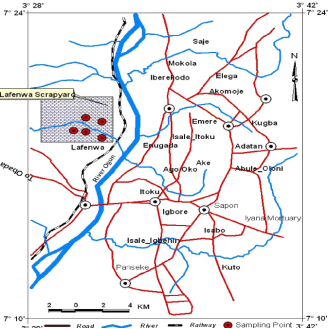
Figure 1. Map of Lafenwa rice husk waste dump, Abeokuta, Ogun state.
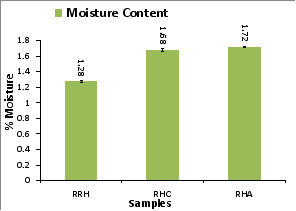
Figure 2. Moisture Content of Rice Husk samples.
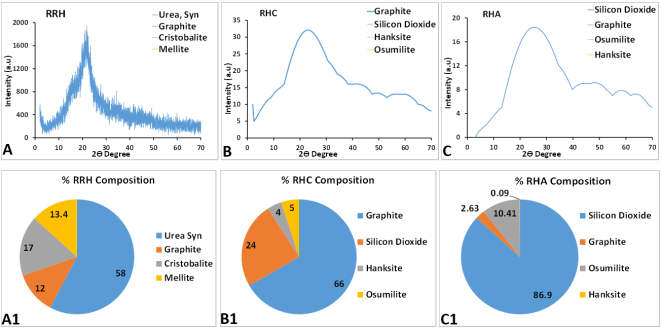
Figure 3. RD spectrum (A) and mineral composition (B) of RRH, RHC and RHA Samples.
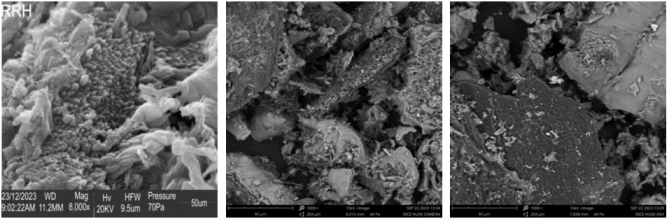
Figure 4. SEM images of RRH, RHC and RHA Samples.
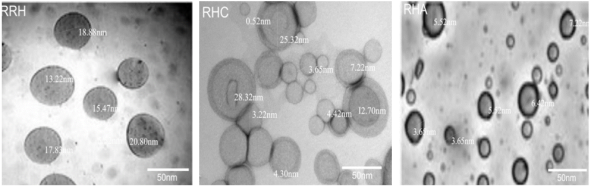
Figure 5. HRTEM images of RRH, RHC and RHA Samples.
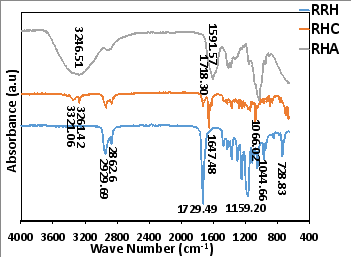
Figure 6. FTIR absorption bands of RRH, RHC and RHA Samples.
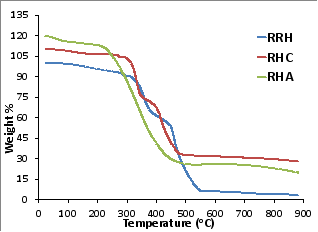
Figure 7. TGA analysis of RRH, RHC and RHA Samples.
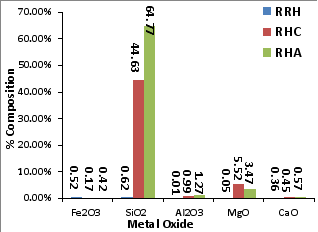
Figure 8. XRF elemental composition (A) and BET Micro pore analysis (B) of RRH, RHC, and RHA Samples.
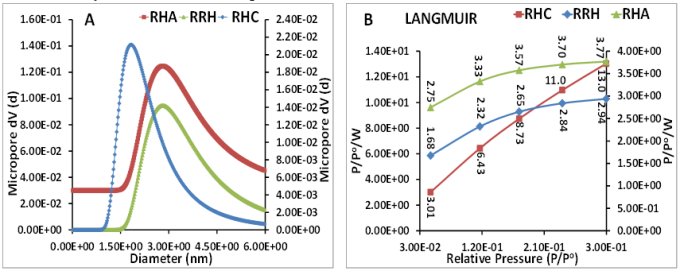
Figure 9. BET Micropore and Langmuir of rice husk and derivatives (RRH, RHC and RHA).
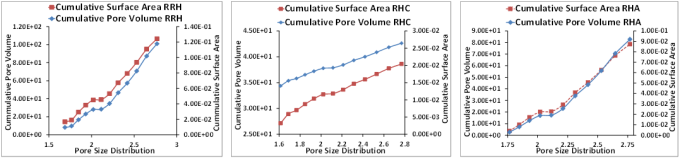
Figure 10. Pore Size Distribution of rice husk and derivatives (RRH, RHC and RHA).
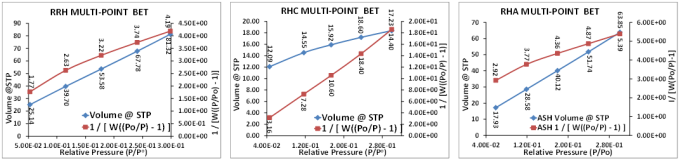
Figure 11. Multi-point BET of rice husk and derivatives (RRH, RHC and RHA).



 Share This Article
 Twitter
 Linked In
 Facebook
 Copy
Copy Download